
2025 Event
Project Overviews
“A successful, longterm
partnership is
built on shared goals
and mutual respect…
Every team member’s
expertise is valued
from project design to
execution.”
PEARL ABU, WACCI
Explore ongoing project areas and related partnerships that were highlighted at the 2025 Africa Crop Forum.
PROJECT 1
Maximising mycorrhizal benefit in major African cereal crops
Prof. Uta Paszkowski, Crop Science Centre
Dr. Pearl Abu, WACCI
Dr. Mavis Owusuaa Osei-Wusu, WACCI
Dr. Jeongmin Choi, University of Cambridge
Dr. Leonie Luginbuehl, University of Cambridge
Our vision is to improve the benefits maize and rice derive from engaging with arbuscular mycorrhizal fungi.
The project focuses on optimising the symbiotic relationship between maize, rice, and arbuscular mycorrhizal fungi,
acting as a natural biofertilizer to enhance mineral nutrition, particularly phosphate. It aims to develop germplasm that maximizes these symbiotic benefits, which could significantly aid in sustainable agriculture by reducing dependency on synthetic fertilizers.

IMPACT
-
For maize and rice QTL and gene leads for beneficial traits and tractable parental contributions will be introgressed into local accessions for use by farmers.
-
Resource development for genomic selection.
-
Development of a pre-breeding population that can be used for crop improvement and mapping of key traits to accelerate future improvement.
PROJECT 2
Improving photosynthesis in an orphan leafy vegetable
Dr. Johannes Kromdijk, University of Cambridge
Prof. Julian Hibbert, University of Cambridge
Dr. Tally Wright, Niab
Dr. Leonie Luginbuehl, University of Cambridge
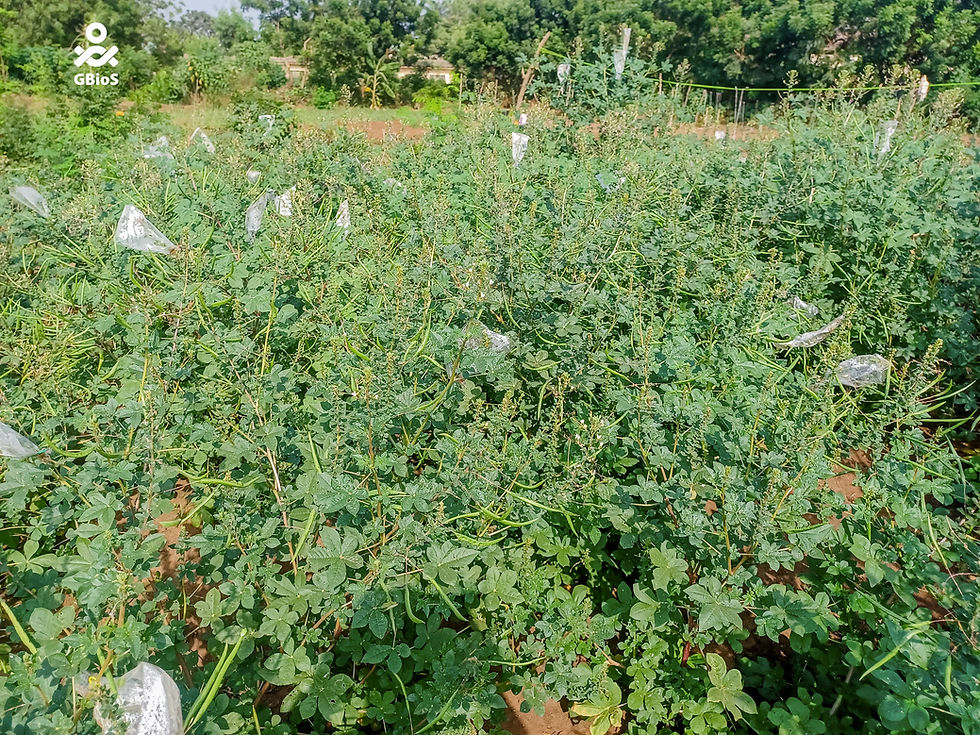
Our vision is to improve photosynthesis and leaf yield in the nutritious African cabbage or spider-plant crop.
The project aims to increase the photosynthetic efficiency of Cleome gynandra, a nutrient-rich orphan vegetable crop known as spider-plant or African cabbage. Improving photosynthesis could lead to better leaf yield and support food security, especially during shortages. The project also aims to create a pre-breeding population based on a diverse genetic background to facilitate future crop improvements.
IMPACT
-
QTL for beneficial traits and tractable parental contributions will be introgressed into local accessions
for use by farmers. -
Resource development for genomic selection.
-
An immortalised pre-breeding population that can be used to for crop improvement and mapping of key traits to accelerate future improvement.
PROJECT 3
Enhancing heat tolerance in major legume crops of Africa
Dr. Natasha Yelina, University of Cambridge
Dr. Ousmane Boukar, IITA
Dr. Maria Muñoz-Amatriaín, Universidad de Leon
Dr. Lovely Mae Lawas, University of Cambridge
Our vision is to develop heat tolerant cowpea for African small-holder farmers.
The project focuses on developing heat-tolerant varieties of cowpea. As global temperatures rise, heat stress becomes a critical challenge for agriculture. Creating varieties that can withstand high temperatures is vital for maintaining crop yields and food security in the face of climate change.

IMPACT
-
Cowpea cultivars with reproductive heat tolerance as a resource for pre-breeding.
-
Traits and associated genomic regions underlying resilience to reproductive heat stress for marker-assisted
breeding. -
New cowpea cultivars with improved reproductive heat resilience.
PROJECT 4
Increasing resilience to pests and diseases
Prof. Sebastian Eves-van den Akker, University of Cambridge
Prof. Ji Zhou, Niab
Dr. Lida Derevnina, University of Cambridge
Dr. Kostya Kanyuka, Niab
Dr. Tom Wood, Niab
Our vision is to mitigate endemic pests and diseases in African legume and tuber crops that threaten food security for small holder farmers.
This project is leveraging their understanding of plant genetics to develop resistance against pests and diseases in tuber
and legume crops. By identifying genetic material that can combat widespread and devastating pathogens, they hope to enhance the long-term capacity to breed crops with effective resistance.

IMPACT
Long-term capacity to breed for effective resistance to endemic pathogens in SSA in legume and tuber crops.
PROJECT 5
Rebuilding cowpea genetic resouces in Somalia
Dr. Ahmed Warsame, Crop Science Centre
Yahye Abdullah Ise, Zamzam University of Science and Technology
Abdirizak Mohamed Sh. Abdi, Zamzam University of Science and Tech.
Abdukadir Isak Nur, Zamzam University of Science and Technology
Our vision is to identify new cowpea cultivars with enhanced climate resilience and improved nutritional quality.
This project focuses on establishing the genetic foundations for cowpea improvement in Somalia. Decades of conflict and climate pressures have severely reduced the diversity of cowpea germplasm available to researchers and farmers. The project is rebuilding these genetic resources by identifying, collecting and characterising currently grown cowpea varieties and historical collections from Somalia that have been obtained from international genebanks. The genetic materials identified in this project will form the basis for future breeding efforts aimed at developing heat- and drought-resilient cowpea suited to the needs of Somali farmers.

IMPACT
-
Elucidate local farmers’ priorities for cowpea improvement and generate the genetic resources required to address.
-
Identify elite lines that can be rapidly advanced for cultivar development.
-
Equip policymakers with robust evidence to inform national strategies for crop resilience and food security.
Interested in the 2026 Africa Crop Forum?
The 2026 forum builds on the partnership model developed through the 2025 event in Cambridge while focusing on African-led priorities, field realities and future funding opportunities.